International Journal of Engineering

International Journal of Engineering

An Interpretable Hybrid Shapley Additive Explanations Brown Bear Optimization Algorithm Predictive Models for End Bearing Capacity of Rock Socketed Piles

Document Type : Original Article

Authors
Department of Civil Engineering, Bozorgmehr University of Qaenat, Qaen, Iran
Abstract
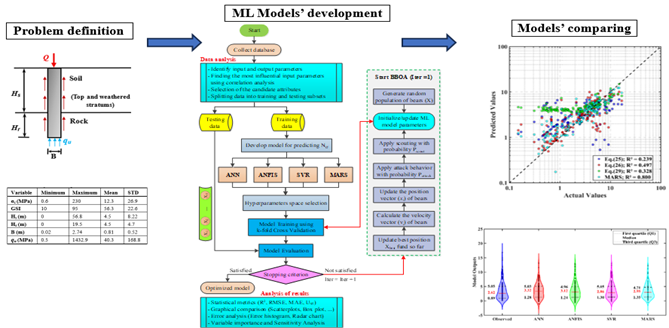
This study develops an interpretable hybrid predictive framework that combines SHapley Additive exPlanations (SHAP) with the Brown-Bear Optimization Algorithm (BBOA) to enhance the prediction of end-bearing capacity (qu) of rock-socketed piles. BBOA is employed to optimize hyperparameters of four machine learning (ML) models—Artificial Neural Networks (ANN), Support Vector Regression (SVR), Adaptive Neuro-Fuzzy Inference Systems (ANFIS), and Multivariate Adaptive Regression Splines (MARS)—leading to significant improvements in accuracy. A novel, interpretable MARS-based predictive formula is also introduced. The model uses pile diameter (B), embedment depths in soil (Hs) and rock (Hr), rock uniaxial compressive strength (σc), and Geological Strength Index (GSI) as inputs. Comprehensive evaluation using multiple statistical metrics (R², RMSE, MAE, U95) reveals that BBOA-ANFIS achieves the highest accuracy during training, while the optimized MARS model performs best in testing, with ANN consistently showing the weakest results. Compared to previous ML-based and empirical models, the proposed models, especially the MARS formula, demonstrate superior accuracy and reliability, with improvements of 11.3% in R², 16.6% in RMSE, and 19.2% in MAE over the best prior empirical model. Additionally, sensitivity analysis and SHAPE-based model interpretation identified key predictors, ranked by influence as σc > GSI > B > Hr > Hs, with σc being the most influential variable and Hs the least. This hybrid approach provides a robust and interpretable tool for accurate and cost-effective pile design in complex soil-rock environments.

Graphical Abstract

An Interpretable Hybrid Shapley Additive Explanations Brown Bear Optimization Algorithm Predictive Models for End Bearing Capacity of Rock Socketed Piles
Keywords

Subjects


  1. Hassan A, Rashid H. Estimation of Ultimate Bearing Capacity in Rock-Socketed Piles Using Optimized Machine Learning Approaches. Advances in Engineering and Intelligence Systems. 2023;2(04):107-20. https://doi.org/10.22034/AEIS.2023.427941.1150
  2. Onyelowe KC, Hanandeh S, Kamchoom V, Ebid AM, Reyes Silva FD, Allauca Palta JL, et al. Developing advanced datadriven framework to predict the bearing capacity of piles on rock. Scientific Reports. 2025;15(1):11051. https://doi.org/10.1038/s41598-025-96186-1
  3. Chen H, Zhang L. A machine learning-based method for predicting end-bearing capacity of rock-socketed shafts. Rock Mechanics and Rock Engineering. 2022;55(3):1743-57. https://doi.org/10.1007/s00603-021-02757-9
  4. Zhang L. Drilled shafts in rock: analysis and design: CRC press; 2004.
  5. Zhang L. Prediction of end-bearing capacity of rock-socketed shafts considering rock quality designation (RQD). Canadian Geotechnical Journal. 2010;47(10):1071-84. https://doi.org/10.1139/T10-016
  6. Zhang R, Xue X. A novel hybrid model for predicting the end‑bearing capacity of rock‑socketed piles. Rock Mechanics and Rock Engineering. 2024;57(11):10099-114. https://doi.org/10.1007/s00603-024-04094-z
  7. Jeong S, Kim D, Park J. Empirical bearing capacity formula for steel pipe prebored and precast piles based on field tests. International Journal of Geomechanics. 2021;21(9):04021165. https://doi.org/10.1061/(ASCE)GM.1943-5622.0002112
  8. Picardo A, Millán M, Galindo R, Alencar A. Revisiting the analytical solutions for ultimate bearing capacity of pile embedded in rocks. Journal of Rock Mechanics and Geotechnical Engineering. 2023;15(6):1506-19. https://doi.org/10.1016/J.JRMGE.2022.11.012
  9. ESLAMI AA, GHOLAMI AM. Analytical model for the ultimate bearing capacity of foundations from cone resistance. 2006.
  10. Yang X, Gong W, Yin Q. Numerical Simulation Study of Bearing Characteristics of Large-Diameter Flexible Piles Under Complex Loads. Buildings. 2024;14(11):3651. https://doi.org/10.3390/buildings14113651
  11. Leong WK, Yusoff NA, Abd Aziz AN, Abu Talib Z. Theoretical and actual bearing capacity of driven piles using model piles in sand. Applied Mechanics and Materials. 2015;773:1453-9. https://doi.org/10.4028/www.scientific.net/AMM.773-774.1453
  12. Gör M. Hybrid predictive machine learning models to evaluate the bearing capacity of concrete and steel piles. Steel and Composite Structures. 2024;53(4):377. https://doi.org/10.12989/scs.2024.53.4.377
  13. Ülker M, Altınok E, Taşkın G. Data-driven modeling of ultimate load capacity of closed-and open-ended piles using machine learning. International Journal of Geotechnical Engineering. 2023;17(4):393-407. https://doi.org/10.1080/19386362.2023.2251795
  14. Fattahi H, Jiryaee F. Estimation of lateral load capacity of piles using a new intelligent combination method. Modares Civil Engineering journal. 2022;22(5):223-33. https://doi.org/10.22034/22.5.223
  15. Alizamir M, Wang M, Ikram RMA, Gholampour A, Ahmed KO, Heddam S, et al. An interpretable XGBoost-SHAP machine learning model for reliable prediction of mechanical properties in waste foundry sand-based eco-friendly concrete. Results in Engineering. 2025;25:104307. https://doi.org/10.1016/j.rineng.2025.104307
  16. Safaeian Hamzehkolaei N, Barkhordari MS. Hybrid soft computing-based predictive models for shear strength of exterior reinforced concrete beam-column joints. Multiscale and Multidisciplinary Modeling, Experiments and Design. 2025;8(1):29. https://doi.org/10.1007/S41939-024-00608-Y/METRICS
  17. Pham TA, Tran VQ, Vu H-LT, Ly H-B. Design deep neural network architecture using a genetic algorithm for estimation of pile bearing capacity. PLoS One. 2020;15(12):e0243030. https://doi.org/10.1371/journal.pone.0243030
  18. Nguyen DD, Nguyen HP, Vu DQ, Prakash I, Pham BT. Using GA-ANFIS machine learning model for forecasting the load bearing capacity of driven piles. Journal of Science and Transport Technology. 2023;3(2):26-33. https://doi.org/10.58845/jstt.utt.2023.en.3.2.26-33
  19. Jebur AA, Atherton W, Alkhadar RM, Loffill E. Piles in sandy soil: A numerical study and experimental validation. Procedia Engineering. 2017;196:60-7. https://doi.org/10.1016/j.proeng.2017.07.173
  20. Jahed Armaghani D, Shoib RSNSBR, Faizi K, Rashid ASA. Developing a hybrid PSO–ANN model for estimating the ultimate bearing capacity of rock-socketed piles. Neural Computing and Applications. 2017;28(2):391-405. https://doi.org/10.1007/s00521-015-2072-z
  21. Benbouras MA, Petrişor A-I, Zedira H, Ghelani L, Lefilef L. Forecasting the bearing capacity of the driven piles using advanced machine-learning techniques. Applied sciences. 2021;11(22):10908. https://doi.org/10.3390/app112210908
  22. Yong W, Zhou J, Jahed Armaghani D, Tahir M, Tarinejad R, Pham BT, et al. A new hybrid simulated annealing-based genetic programming technique to predict the ultimate bearing capacity of piles. Engineering with Computers. 2021;37(3):2111-27. https://doi.org/10.1007/s00366-019-00932-9
  23. Armaghani DJ, Harandizadeh H, Momeni E, Maizir H, Zhou J. An optimized system of GMDH-ANFIS predictive model by ICA for estimating pile bearing capacity. Artificial Intelligence Review. 2022;55(3):2313-50. https://doi.org/10.1007/s10462-021-10065-5
  24. Pham TA, Vu H-LT. Application of ensemble learning using weight voting protocol in the prediction of pile bearing capacity. Mathematical Problems in Engineering. 2021;2021(1):5558449. https://doi.org/10.1155/2021/5558449
  25. Harandizadeh H, Jahed Armaghani D, Khari M. A new development of ANFIS–GMDH optimized by PSO to predict pile bearing capacity based on experimental datasets. Engineering with Computers. 2021;37(1):685-700. https://doi.org/10.1007/s00366-019-00849-3
  26. Gohil R, Parthasarathy C, editors. Intelligent Assessment of Axial Capacity of Pipe Piles Using High Strain Dynamic Pile Load Tests in Offshore Environment. Indian Geotechnical Conference; 2021: Springer.
  27. Hoang N-D, Tran X-L, Huynh T-C. Prediction of Pile Bearing Capacity Using Opposition‐Based Differential Flower Pollination‐Optimized Least Squares Support Vector Regression (ODFP‐LSSVR). Advances in Civil Engineering. 2022;2022(1):7183700. https://doi.org/10.1155/2022/7183700
  28. Amâncio LB, Dantas SA, Cunha RPd. Estimative of shaft and tip bearing capacities of single piles using multilayer perceptrons. Soils and Rocks. 2022;45(3):e2022077821. https://doi.org/10.28927/SR.2022.077821
  29. Jin L, Ji Y. Development of an IRMO-BPNN based single pile ultimate axial bearing capacity prediction model. Buildings. 2023;13(5):1297. https://doi.org/10.3390/buildings13051297
  30. Shoaib MM, Abu-Farsakh MY. Exploring tree-based machine learning models to estimate the ultimate pile capacity from cone penetration test data. Transportation Research Record. 2024;2678(1):136-49. https://doi.org/10.1177/03611981231170128
  31. Assaad RH, Hu X, Hussein M. Expert knowledge–guided Bayesian belief networks for predicting bridge pile capacity. Journal of Bridge Engineering. 2023;28(9):04023058. https://doi.org/10.1061/jbenf2.beeng-6096
  32. Shen Y. Optimized systems of multi-layer perceptron predictive model for estimating pile-bearing capacity. Journal of Engineering and Applied Science. 2024;71(1):52. https://doi.org/10.1186/s44147-024-00386-x
  33. Picardo A, Millán M, Galindo R, Andrés-Hernandez J, de Alencar AS, editors. Pile tip bearing capacity in rock masses: analytical and numerical analysis comparison. IOP Conference Series: Earth and Environmental Science; 2023: IOP Publishing.
  34. You R, Mao H. Assessment of ultimate bearing capacity of rock-socketed piles using hybrid approaches. Multiscale and Multidisciplinary Modeling, Experiments and Design. 2024;7(4):3673-94. https://doi.org/10.1007/s41939-024-00425-3
  35. Kumar M, Kumar DR, Khatti J, Samui P, Grover KS. Prediction of bearing capacity of pile foundation using deep learning approaches. Frontiers of Structural and Civil Engineering. 2024;18(6):870-86. https://doi.org/10.1007/s11709-024-1085-z
  36. Ren J, Sun X. Prediction of ultimate bearing capacity of pile foundation based on two optimization algorithm models. Buildings. 2023;13(5):1242. https://doi.org/10.3390/buildings13051242
  37. Galib MMH, Billah MM, Mofiz SA, editors. Prediction of bearing capacity of pile using support vector and catboost regression. AIP Conference Proceedings; 2025: AIP Publishing LLC.
  38. Millán M, Picardo A, Galindo R. Application of artificial neural networks for predicting the bearing capacity of the tip of a pile embedded in a rock mass. Engineering Applications of Artificial Intelligence. 2023;124:106568. ttps://doi.org/10.1016/j.engappai.2023.106568
  39. Hoek E, Brown ET. Practical estimates of rock mass strength. International journal of rock mechanics and mining sciences. 1997;34(8):1165-86. https://doi.org/10.1016/S1365-1609(97)80069-X
  40. Vatani A, Jafari-Asl J, Ohadi S, Safaeian Hamzehkolaei N, Afzali Ahmadabadi S, Correia JA, editors. An efficient surrogate model for reliability analysis of the marine structure piles. Proceedings of the Institution of Civil Engineers-Maritime Engineering; 2023: Emerald Publishing Limited.
  41. Zarbazoo Siahkali M, Ghaderi A, Bahrpeyma AH, Rashki M, Safaeian Hamzehkolaei N. Estimating pier scour depth: comparison of empirical formulations with ANNs, GMDH, MARS, and Kriging. Journal of AI and Data Mining. 2021;9(1):109-28. https://doi.org/10.22044/jadm.2020.10085.2147
  42. Safaeian Hamzehkolaei N, Miri M, Rashki M. An improved binary bat flexible sampling algorithm for reliability-based design optimization of truss structures with discrete-continuous variables. Engineering Computations. 2018;35(2):641-71. https://doi.org/10.1108/EC-06-2016-0207
  43. Safaeian Hamzehkolaei N, MiarNaeimi F. A new hybrid multi-level cross-entropy-based moth-flame optimization algorithm. Soft Computing. 2021;25(22):14245-79. https://doi.org/10.1007/s00500-021-06109-1
  44. Khastar S, Bashirizadeh F, Jafari-Asl J, Safaeian Hamzehkolaei N. Predicting the cooling and heating loads of energy efficient buildings: a hybrid machine learning approach. Cluster Computing. 2025;28(5):1-18. https://doi.org/10.1007/S10586-024-04993-4/FIGURES/3
  45. Hamzehkolaei NS, Kadkhoda N. An efficient ranked Voronoi diagram-based hybrid method for reliability-based structural analysis and design optimization. Soft Computing. 2023;27(19):13889-910. https://doi.org/10.1007/s00500-023-08450-z
  46. Hamzehkolaei NS, Ghavaminejadb S, Barkhordaric M. Predictive Model of Bond Strength in Reinforced Concrete Structures: A Hybrid Metaheuristic-optimized Neural Network Approach. International Journal of Engineering, Transactions B: Applications. 2025;38(5):1190-212. https://doi.org/10.5829/IJE.2025.38.05B.19
  47. Barkhordari M, Khoshnazar S. Fuzzy-enhanced Convolutional Neural Network for Predicting Structural Responses to Seismic Excitations. International Journal of Engineering, Transactions B: Applications. 2025;38(6):1293-306. https://doi.org/10.5829/ije.2025.38.06c.04
  48. Prakash T, Singh PP, Singh VP, Singh SN. A novel brown-bear optimization algorithm for solving economic dispatch problem. Advanced control & optimization paradigms for energy system operation and management: River Publishers; 2023. p. 137-64.
  49. Zhang G, Hamzehkolaei NS, Rashnoozadeh H, Band SS, Mosavi A. Reliability assessment of compressive and splitting tensile strength prediction of roller compacted concrete pavement: introducing MARS-GOA-MCS. International Journal of Pavement Engineering. 2022;23(14):5030-47. https://doi.org/10.1080/10298436.2021.1990920
  50. Azar NA, Kardan N, Milan SG. Developing the artificial neural network–evolutionary algorithms hybrid models (ANN–EA) to predict the daily evaporation from dam reservoirs. Engineering with Computers. 2023;39(2):1375-93. https://doi.org/10.1007/s00366-021-01523-3
  51. Moodi Y, Hamzehkolaei NS, Afshoon I. Intelligent Models for Predicting the Compressive Strength of Green Concrete Made with Fine and Coarse Grains of Waste Copper Slag. 2024. https://doi.org/10.48301/KSSA.2024.441580.2833
  52. Ashrafian A, Hamzehkolaei NS, Dwijendra NKA, Yazdani M. An evolutionary neuro-fuzzy-based approach to estimate the compressive strength of eco-friendly concrete containing recycled construction wastes. Buildings. 2022;12(8):1280. https://doi.org/10.3390/buildings12081280
  53. Moodi Y, Hamzehkolaei NS, Afshoon I. Machine learning models for predicting compressive strength of eco-friendly concrete with copper slag aggregates. Materials Today Communications. 2025:112572. https://doi.org/10.1016/j.mtcomm.2025.112572
  54. Safaeian Hamzehkolaei N, Alizamir M. Performance evaluation of machine learning algorithms for seismic retrofit cost estimation using structural parameters. Journal of Soft Computing in Civil Engineering. 2021;5(3):32-57. https://doi.org/10.22115/SCCE.2021.284630.1312
  55. Lundberg SM, Lee S-I. A unified approach to interpreting model predictions. Advances in neural information processing systems. 2017;30. https://arxiv.org/abs/1705.07874v2