International Journal of Engineering

International Journal of Engineering

Effect of Foundation Flexibility on Seismic Energy Dissipation in RC Bridges Subjected to Fling-step Ground Motions

Document Type : Original Article

Authors
1 Department of Civil Engineering, FE&T, Jamia Millia Islamia, New Delhi, India
2 Department of Architecture, FA&E, Jamia Millia Islamia, New Delhi, India
Abstract
Bridges are critical components of transportation networks, particularly in the aftermath of seismic events when their continued operation is essential for emergency response and recovery. The severity of seismic impact on a bridge depends largely on the characteristics of ground motion and the structure’s proximity to the fault. While bridges located in far-field regions may experience moderate effects, those situated in near-fault (NF) zones—typically within 15 km of a fault rupture—are highly susceptible to severe damage due to intense ground motions. NF ground motions (NF-GMs) are distinguished by high-energy velocity pulses, long-period pulse-like waveforms, and high peak values that pose significant demands on structures. Although several studies have investigated the seismic vulnerability of bridges under NF-GMs, most assume fixed-base conditions and neglect the influence of soil flexibility. The role of soil-structure interaction (SSI) in altering the seismic performance of reinforced concrete (RC) bridges under such demands remains inadequately addressed. This study performs a comparative vulnerability assessment of a simply supported multi-span RC bridge subjected to NF-GMs with forward directivity and fling step (FS) effects. Incremental Dynamic Analysis (IDA) is carried out, and fragility curves were developed to quantify the probability of damage across two configurations: a fixed-base model and a flexible-base model incorporating SSI via a pile group foundation. The results indicate that the flexible-base model experiences higher displacement demands but reduced base shear, while the fixed-base model exhibits greater stiffness and force transmission. These findings underscore the need to incorporate SSI in seismic vulnerability assessments of bridges in NF regions.

Graphical Abstract

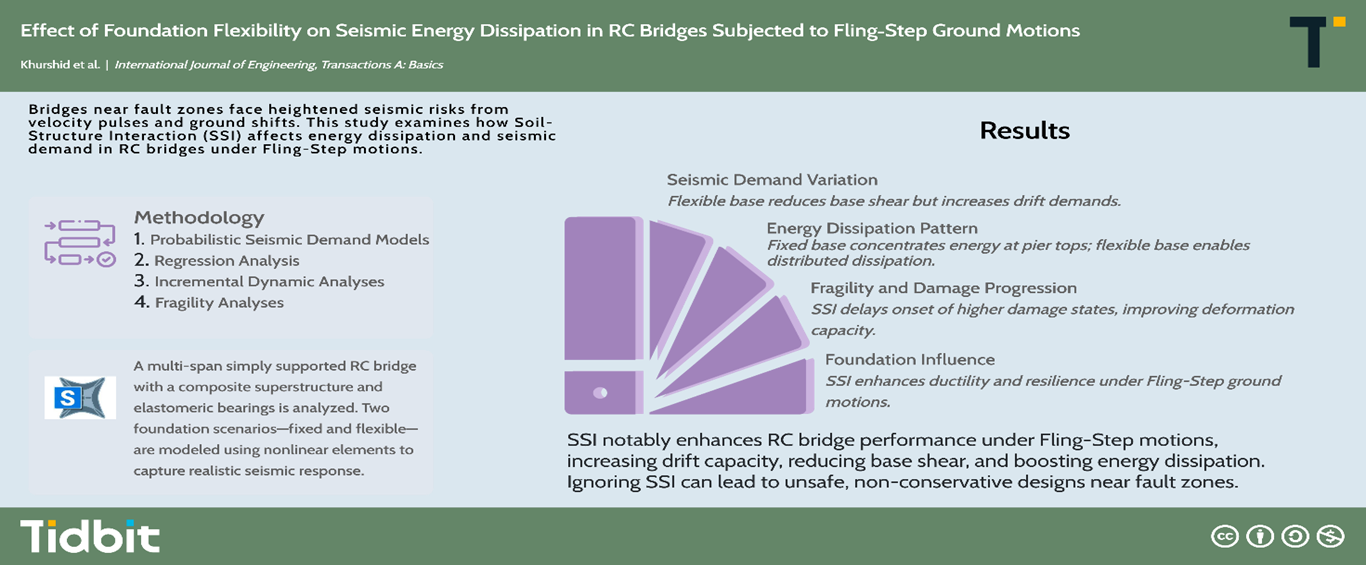
Effect of Foundation Flexibility on Seismic Energy Dissipation in RC Bridges Subjected to Fling-step Ground Motions
Keywords

Subjects


  1. Han Q, Du X, Liu J, Li Z, Li L, Zhao J. Seismic damage of highway bridges during the 2008 Wenchuan earthquake. Earthquake Engineering and Engineering Vibration. 2009;8(2):263-73. https://doi.org/10.1007/s11803-009-8162-0
  2. Carbonari S, Dezi F, Leoni G. Seismic soil–structure interaction in multi‐span bridges: application to a railway bridge. Earthquake engineering & structural dynamics. 2011;40(11):1219-39. https://doi.org/10.1002/eqe.1085
  3. Alavi B, Krawinkler H. Behavior of moment‐resisting frame structures subjected to near‐fault ground motions. Earthquake engineering & structural dynamics. 2004;33(6):687-706. https://doi.org/10.1002/eqe.369
  4. Chiou B-J, Youngs RR. An NGA model for the average horizontal component of peak ground motion and response spectra. Earthquake spectra. 2008;24(1):173-215. https://doi.org/10.1193/1.2894832
  5. Mavroeidis GP, Papageorgiou AS. A mathematical representation of near-fault ground motions. Bulletin of the seismological society of America. 2003;93(3):1099-131. https://doi.org/10.1785/0120020100
  6. Somerville PG. Magnitude scaling of the near fault rupture directivity pulse. Physics of the earth and planetary interiors. 2003;137(1-4):201-12. https://doi.org/10.1016/S0031-9201(03)00015-3
  7. Baker JW. Quantitative classification of near-fault ground motions using wavelet analysis. Bulletin of the seismological society of America. 2007;97(5):1486-501. https://doi.org/10.1785/0120060255
  8. Kamai R, Abrahamson NA, Silva WJ. Nonlinear horizontal site amplification for constraining the NGA-West2 GMPEs. Earthquake Spectra. 2014;30(3):1223-40. https://doi.org/10.1193/070113EQS187M
  9. Zheng Y, Wang J, Xu W, Li N, Zhang W, Chen Y. Impact of Near-Fault Ground Motions on Longitudinal Seismic Response of CHRF Bridges. Sustainability. 2022;14(6):3591. https://doi.org/10.3390/su14063591
  10. Hui Y, Fan L, Lv J, Li J, Jia H, editors. Influence of velocity pulse directivity on seismic response of cross-fault bridges. Structures; 2024: Elsevier.
  11. Bhagat S, Wijeyewickrema AC, Subedi N. Influence of near-fault ground motions with fling-step and forward-directivity characteristics on seismic response of base-isolated buildings. Journal of Earthquake Engineering. 2021;25(3):455-74. https://doi.org/10.1080/13632469.2018.1520759
  12. Baig MA, Ansari MI, Islam N, Umair M. Probabilistic damage evaluation of isolated steel box-girder bridge excited by near-field earthquakes. Soil Dynamics and Earthquake Engineering. 2024;184:108869. https://doi.org/10.1016/j.soildyn.2024.108869
  13. Albusoda BS, A'amal A, Al-Khayyat BH. Challenges of Soil-Structure Interaction Problems–A Review. Journal of Engineering. 2025;31(5):75-98. https://doi.org/10.31026/j.eng.2025.05.05
  14. Stefanidou SP, Sextos AG, Kotsoglou AN, Lesgidis N, Kappos AJ. Soil-structure interaction effects in analysis of seismic fragility of bridges using an intensity-based ground motion selection procedure. Engineering Structures. 2017;151:366-80. https://doi.org/10.1016/j.engstruct.2017.08.033
  15. Mylonakis G, Nikolaou S, Gazetas G. Footings under seismic loading: Analysis and design issues with emphasis on bridge foundations. Soil Dynamics and Earthquake Engineering. 2006;26(9):824-53. https://doi.org/10.1016/j.soildyn.2005.12.005
  16. Izhar MS, Ansari MI, Umair M. Correction: Energy based seismic vulnerability assessment tool for reinforced concrete bridges. Bulletin of Earthquake Engineering. 2024;22(11):5951-. https://doi.org/10.1007/s10518-024-01986-x
  17. Baig M, Ansari M, Islam N, Umair M. Probabilistic Damage Analysis of Isolated Steel Tub Girder Bridge Excited by Near and Far Fault Ground Motions. International Journal of Engineering Transactions B: Applications. 2023;36(2):289-98. https://doi.org/10.5829/IJE.2023.36.02B.09
  18. Nazri FM, Yerna CK, Kassema MM, Farsangib EN. Assessment of structure-specific fragility curves for soft storey buildings implementing IDA and SPO approaches. International Journal of Engineering. 2018;31(12):2016-21. 10.5829/ije.2018.31.12c.04
  19. Prestandard F. commentary for the seismic rehabilitation of buildings (FEMA356). Washington, DC: Federal Emergency Management Agency. 2000;7(2):518.
  20. Cornell CA, Jalayer F, Hamburger RO, Foutch DA. Probabilistic basis for 2000 SAC federal emergency management agency steel moment frame guidelines. Journal of structural engineering. 2002;128(4):526-33. https://doi.org/10.1061/(ASCE)0733-9445(2002)128:4(526)
  21. Walls S. FEMA 356 prestandard and commentary for the seismic rehabilitation of buildings. ASCE for the Federal Emergency Management Agency. 2000:889-90.
  22. Jalayer F, Cornell CA. Alternative non‐linear demand estimation methods for probability‐based seismic assessments. Earthquake Engineering & Structural Dynamics. 2009;38(8):951-72. https://doi.org/10.1002/eqe.876
  23. Mei H, Guo A. Probabilistic hazard assessment of bridges under multihazard actions during the life-cycle period. Natural Hazards Review. 2024;25(2):04024001. https://doi.org/10.1061/NHREFO.NHENG-1679
  24. Izhar MS, Ansari MI, Umair M. Energy based seismic vulnerability assessment tool for reinforced concrete bridges. Bulletin of Earthquake Engineering. 2024;22(10):5259-97. https://doi.org/10.1007/s10518-024-01969-y
  25. Standards BoI. Criteria for earthquake resistant design of structures. 2002.
  26. Council AT. Quantification of building seismic performance factors: US Department of Homeland Security, FEMA; 2009.
  27. Paulay T, Priestley MN. Seismic design of reinforced concrete and masonry buildings: Wiley New York; 1992.
  28. Caltrans S. Caltrans seismic design criteria version 1.6. California Department of Transportation, Sacramento. 2010.
  29. Naeim F, Kelly JM. Design of seismic isolated structures: from theory to practice: John Wiley & Sons; 1999.
  30. Roeder CW, Stanton JF, Taylor AW. Performance of elastomeric bearings1987.
  31. Atefatdoost GR, JavidSharifi B, Shakib H. Effects of foundation flexibility on seismic demands of asymmetric buildings subject to near-fault ground motions. Structural Engineering and Mechanics, An Int'l Journal. 2018;66(5):637-48.
  32. Boulanger RW, Curras CJ, Kutter BL, Wilson DW, Abghari A. Seismic soil-pile-structure interaction experiments and analyses. Journal of geotechnical and geoenvironmental engineering. 1999;125(9):750-9. https://doi.org/10.1061/(ASCE)1090-0241(1999)125:9(750)
  33. Rp2a-Wsd A. Recommended practice for planning, designing and constructing fixed offshore platforms–working stress design–. Twenty-2000. 2000.
  34. Ajom B, Bhattacharjee A, editors. Effect of earthquake on bridge foundation. 13th International Conference on Vibration Problems ICOVP, Indian Institute of Technology Guwahati, India; 2017.
  35. Goodnight JC. The effects of load history and design variables on performance limit states of circular bridge columns: North Carolina State University; 2015.
  36. El Bahy A. Cumulative seismic damage of reinforced concrete bridge piers. 1996.
  37. Mallick M, Raychowdhury P. Seismic analysis of highway skew bridges with nonlinear soil–pile interaction. Transportation Geotechnics. 2015;3:36-47. https://doi.org/10.1016/j.trgeo.2015.03.002
  38. Bhandari M, Bharti S, Shrimali M, Datta T. Seismic fragility analysis of base-isolated building frames excited by near-and far-field earthquakes. Journal of Performance of Constructed Facilities. 2019;33(3):04019029. https://doi.org/10.1061/(ASCE)CF.1943-5509.0001298
  39. Yadav KK, Gupta VK. Near-fault fling-step ground motions: Characteristics and simulation. Soil Dynamics and Earthquake Engineering. 2017;101:90-104. https://doi.org/10.1016/j.soildyn.2017.06.022
  40. Miano A, Iacovazzo P, Mele A, Di Ludovico M, Prota A. Seismic fragility of circular piers in simply supported RC bridges: a proposal for capacity assessment. Engineering Structures. 2024;302:117426. https://doi.org/10.1016/j.engstruct.2023.117426
  41. Kalkan E, Kunnath SK. Effects of fling step and forward directivity on seismic response of buildings. Earthquake spectra. 2006;22(2):367-90. https://doi.org/10.1193/1.2192560
  42. Kircher C, Deierlein G, Hooper J, Krawinkler H, Mahin S, Shing B, et al. Evaluation of the FEMA P-695 methodology for quantification of building seismic performance factors. 2010.
  43. Padgett JE, Nielson BG, DesRoches R. Selection of optimal intensity measures in probabilistic seismic demand models of highway bridge portfolios. Earthquake engineering & structural dynamics. 2008;37(5):711-25. https://doi.org/10.1002/eqe.782
  44. Jiang L, Zhong J, Yuan W, editors. The pulse effect on the isolation device optimization of simply supported bridges in near-fault regions. Structures; 2020: Elsevier.
  45. Billah AM, Alam MS, Bhuiyan MR. Fragility analysis of retrofitted multicolumn bridge bent subjected to near-fault and far-field ground motion. Journal of Bridge Engineering. 2013;18(10):992-1004. https://doi.org/10.1061/(ASCE)BE.1943-5592.0000452
  46. Kabir MR, Billah AM, Alam MS, editors. Seismic fragility assessment of a multi-span RC bridge in Bangladesh considering near-fault, far-field and long duration ground motions. Structures; 2019: Elsevier.
  47. Jagan P, Visuvasam JA. Assessment of the influence of nonlinear soil effects on seismic response of RC structures with floating columns considering soil–structure interaction. Geomatics, Natural Hazards and Risk. 2024;15(1):2401997. https://doi.org/10.1080/19475705.2024.2401997
  48. Amendola C, Pitilakis D. Vulnerability assessment of historical cities including SSI and site-effects. Geotechnical Engineering for the Preservation of Monuments and Historic Sites III: CRC Press; 2022. p. 836-46.