International Journal of Engineering

International Journal of Engineering

Thermophysical Treatment of Petroleum Coke-Based Electrode Paste as a New Promising Approach to Integrating the Oil Refining and Metallurgical Industries for Carbon-Graphite Electrode Production

Document Type : SPMU 2026

Authors
Faculty of Mineral Processing, Saint Petersburg Mining University, St. Petersburg, Russian Federation
Abstract
The study focuses on developing a thermophysical treatment technology for petroleum coke to create a homogeneous layered structure required for producing high-performance electrodes in metallurgical and petrochemical industries. The relevance stems from the shortage of anisotropic petroleum coke in the Russian market and the need to enhance the competitiveness of domestic electrode products. The objective of the study is to develop and experimentally validate a technology that improves the structural anisotropy of carbon material. The materials used include samples of green petroleum coke calcined in an inert atmosphere and coke-pitch charge subjected to thermal and mechanical treatment. An experimental setup with an extruder (heating up to 520°C, pressure up to 100 MPa) was developed, alongside structural analysis methods such as FTIR spectroscopy, SEM and XRD analyses. Results confirmed increased material homogeneity, enhanced graphitization tendency, and improved electrode performance, made by treated carbon material. The technology demonstrates potential for industrial implementation, fostering new production chains for carbon-graphite products and increasing oil refining profitability.

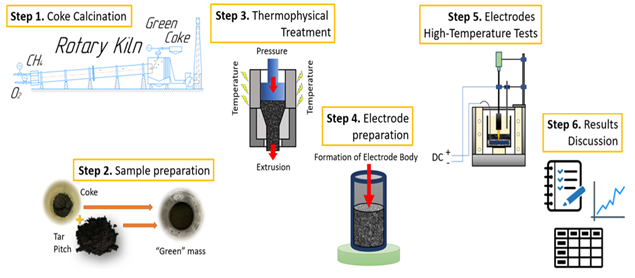
Graphical Abstract

Thermophysical Treatment of Petroleum Coke-Based Electrode Paste as a New Promising Approach to Integrating the Oil Refining and Metallurgical Industries for Carbon-Graphite Electrode Production
Keywords

Subjects


  1. Echterhof T. Review on the use of alternative carbon sources in EAF steelmaking. Metals. 2021;11(2):222. https://doi.org/10.3390/met11020222
  2. Wang X, He L, Liu W, Zhou J, Peng Q, Fan M, et al. Correlation between chemical composition, wettability and carbon anode performance: Exploration of high quality carbon anode preparation for aluminum electrolysis. Fuel. 2024;357:129823. https://doi.org/10.1016/J.FUEL.2023.129823
  3. Sakvand M, Shojaie-Bahaabad M, Nikzad L. Effect of graphite addition on the microstructure, mechanical properties and oxidation resistance of HfB2-SiC composites prepared by the SPS method. International Journal of Engineering, Transactions A: Basics. 2022;35(10):1867-76. https://doi.org/10.5829/IJE.2022.35.10A.06
  4. Zhang Z, Chen K, Liu D, Lou B, Li M, Guo S, et al. Comparative study of the carbonization process and structural evolution during needle coke preparation from petroleum and coal feedstock. Journal of Analytical and Applied Pyrolysis. 2021;156:105097. https://doi.org/10.1016/J.JAAP.2021.105097
  5. Nazarenko MY, Saltykova, S. N. Influence of oil shale semi-coking parameters on the quality of shale semi-coke. Bulletin of the Tomsk Polytechnic University, Geo Assets Engineering. 2021;332(9):109–18. https://doi.org/10.18799/24131830/2021/9/3361
  6. Savchenkov S. The research of obtaining master alloys magnesium-gadolinium process by the method of metallothermic recovery. Tsvetnye Met. 2019;5:33-9. https://doi.org/10.17580/TSM.2019.05.04
  7. Heintz EA. Influence of coke structure on the properties of the carbon-graphite artefact. Fuel. 1985;64(9):1192-6. https://doi.org/10.1016/0016-2361(85)90173-5
  8. Litvinova TE, Tsareva AA, Poltoratskaya ME, Rudko VA. The mechanism and thermodynamics of ethyl alcohol sorption process on activated petroleum coke. Записки Горного института. 2024(268 (eng)):625-36. https://pmi.spmi.ru/pmi/article/view/16330
  9. Lou B, Zhang J, Li J, Chai L, Shi N, Wen F, et al. Comparative study on devolatilization behavior, microstructural evolution and resultant properties during calcination of petroleum coke with distinct mesophase texture. Journal of Analytical and Applied Pyrolysis. 2024;177:106329. https://doi.org/10.1016/J.JAAP.2023.106329
  10. Martynov S, Liu Z. Controlled placement of electrodes in an ore-smelting furnace and its effect on the reaction zone. Metallurgist. 2024;67(11):1866-77. https://doi.org/10.1007/s11015-024-01684-8
  11. Gorlanov E, Brichkin V, Polyakov A. Electrolytic production of aluminium. Review. Part 1. Conventional areas of development. Tsvetn Met. 2020:36-41. https://doi.org/10.17580/TSM.2020.10.06
  12. Justin Raj Y, Bovas Herbert Bejaxhin, A., Rajkumar, S., Selvarajan, L., Premkumar, R. . Enhancing Efficiency in Thermoelectric Removal Process: A Comprehensive Study on P/M-Made Al-Cu-ZrB2 Nano-Composite Electrodes on SS205 Alloy. International Journal of Engineering Transactions C: Aspects. 2025;38(3):570-9. https://doi.org/10.5829/ije.2025.38.03c.06
  13. Feshchenko RY, Erokhina O, Litavrin I, Ryaboshuk S. Improvement of oxidation resistance of arc furnace graphite electrodes. Chernye Met. 2023;7:31-6. https://doi.org/10.17580/CHM.2023.07.03
  14. Martynov S, Masko O, Fedorov S. Innovative ore-thermal furnace control systems. Tsvetnye metally. 2022;4:87-94. https://doi.org/10.17580/tsm.2022.04.11
  15. Gorlanov ES, Mushihin EA, Schneider SR, Kovalskaya KV. Synthesis of Carbon–TiC/TiB2 Composites at the Electrolytic Reduction of Fused Salts. Journal of The Electrochemical Society. 2023;170(10):102501. https://doi.org/10.1149/1945-7111/acfac4
  16. Feshchenko RY, Eremin R, Erokhina O, Povarov V. Improvement of oxidation resistance of graphite blocks for the electrolytic production of magnesium by impregnation with phosphate solutions. Part 2. Tsvetnye Met. 2022. https://doi.org/10.17580/tsm.2022.01.02
  17. Li C, Chen X, Shen L, Bao N. Revisiting the oxidation of graphite: Reaction mechanism, chemical stability, and structure self-regulation. ACS omega. 2020;5(7):3397-404. https://doi.org/10.1021/ACSOMEGA.9B03633/SUPPL_FILE/AO9B03633_SI_001.PDF
  18. Rudko VA, Gabdulkhakov RR, Pyagai IN. Scientific and technical substantiation of the possibility for the organization of needle coke production in Russia. Записки Горного института. 2023(263 (eng)):795-809. https://pmi.spmi.ru/pmi/article/view/16246
  19. Litvinenko VS, Petrov EI, Vasilevskaya DV, Yakovenko AV, Naumov IA, Ratnikov MA. Assessment of the role of the state in the management of mineral resources. Записки Горного института. 2023(259 (eng)):95-111. https://doi.org/10.31897/PMI.2022.100
  20. Tsareva A, Litvinova T, Gapanyuk D, Rode L, Poltoratskaya M. Kinetic calculation of sorption of ethyl alcohol on carbon materials. Russian Journal of Physical Chemistry A. 2024;98(3):421-30. https://doi.org/10.1134/S0036024424030312
  21. Kondrasheva N, Vasil’ev V, Boitsova A. Study of Feasibility of Producing High-Quality Petroleum Coke from Heavy Yarega Oil. Chemistry and Technology of Fuels and Oils. 2017;52:663-9. https://doi.org/10.1007/S10553-017-0758-X
  22. Gabdulkhakov RR, Samigullin, A. R., Hafizi, A., Rudko, V. А., Pyagay, I. N. Polymer-modified Needle Coke Properties Formation During High Temperature Calcination. International Journal of Engineering Transactions B: Applications. 2025;38(8):1864-73. https://doi.org/10.5829/ije.2025.38.08b.11
  23. Ying L, Dengpeng C, Wei W, Dongsheng L, Junwei W, Yudong L, et al. Influences of heat treatment on the oxidation and corrosion behavior of Cu–Ni–Fe inert anodes for aluminium electrolysis. Journal of Alloys and Compounds. 2020;832:154848. https://doi.org/10.1016/J.JALLCOM.2020.154848
  24. Ismagilov Z, Sozinov S, Popova A, Zaporin V. Structural analysis of needle coke. Coke and Chemistry. 2019;62:135-42. https://doi.org/10.3103/S1068364X19040021/METRICS
  25. Mondal S, Yadav A, Pandey V, Sugumaran V, Bagai R, Kumar R, et al. Dissecting the cohesiveness among aromatics, saturates and structural features of aromatics towards needle coke generation in DCU from clarified oil by analytical techniques. Fuel. 2021;304:121459. https://doi.org/10.1016/J.FUEL.2021.121459
  26. Zhang X, He J, Lian J, Piao H, Li X. Evolution of Microstructure during Calcination Process and Performance Study of Petroleum Coke. Solid Fuel Chemistry. 2025;59(1):27-37. https://doi.org/10.3103/S0361521924700472
  27. Fedorova E, Pupysheva E. Effect of variation of internal diameter along the length of a rotary kiln on material movement. Non-Ferr Met. 2024(1.):28-34. https://doi.org/10.17580/nfm.2024.01.05
  28. Wallouch R, Fair F. Kinetics of the coke shrinkage process during calcination. Carbon. 1980;18(2):147-53. https://doi.org/10.1016/0008-6223(80)90023-8
  29. Apal’kova G. Destruction of graphitized electrodes under the conditions of thermal shock. Refractories and Industrial Ceramics. 2018;59:163-9. https://doi.org/10.1007/S11148-018-0199-Z/METRICS
  30. Zhong Q, Mao Q, Zhang L, Xiang J, Xiao J, Mathews JP. Structural features of Qingdao petroleum coke from HRTEM lattice fringes: Distributions of length, orientation, stacking, curvature, and a large-scale image-guided 3D atomistic representation. Carbon. 2018;129:790-802. https://doi.org/10.1016/J.CARBON.2017.12.106
  31. Yu Y, Wang F, Biney BW, Li K, Jiao S, Chen K, et al. Co-carbonization of ethylene tar and fluid catalytic cracking decant oil: Development of high-quality needle coke feedstock. Fuel. 2022;322:124170. https://doi.org/10.1016/J.FUEL.2022.124170
  32. Zhang Z, Lou B, Guo S, Zhu W, Gu M, Huang X, et al. Study on preparation of composite carbon rod for high-power electrode from coke with different structural characteristics. Journal of Analytical and Applied Pyrolysis. 2022;165:105551. https://doi.org/10.1016/j.jaap.2022.105551
  33. Zhu H, Zhu Y, Xu Y, Hu C, Lai S, Gao L, et al. Transformation of microstructure of coal‐based and petroleum‐based needle coke: Effects of calcination temperature. Asia‐Pacific Journal of Chemical Engineering. 2021;16(5):e2674. https://doi.org/10.1002/APJ.2674
  34. Gutiérrez E, Salazar E, Salinas A, Deaquino R, Ponce A, Yacaman M, et al. Texture, microstructure and mechanical properties of AA7075-graphite composites produced through mechanical alloying and hot-extrusion. Materials Chemistry and Physics. 2023;296:127323. https://doi.org/10.1016/J.MATCHEMPHYS.2023.127323
  35. Yumeng Y, Jiangzhong L, Mingyi C. Superfine comminution characteristics of low-rank coal pyrolysis semicokes and evolution of fragmentation fractal dimension. Fuel. 2022;325:124991. https://doi.org/10.1016/J.FUEL.2022.124991
  36. Sharikov YV, Sharikov FY, Krylov K. Mathematical model of optimum control for petroleum coke production in a rotary tube kiln. Theoretical Foundations of Chemical Engineering. 2021;55:711-9. https://doi.org/10.1134/S0040579521030192
  37. McCreery RL, Cline KK. Carbon electrodes. Laboratory Techniques in Electroanalytical Chemistry, Revised and Expanded: CRC Press; 2018. p. 293-332.