International Journal of Engineering

International Journal of Engineering

A Novel Approach for Accurate Wind Speed Time Series Forecasting Using ICEEMDAN Decomposition and Sample Entropy through Integration of Deep Learning Models

Document Type : Original Article

Authors
1 Department of Electronics, Faculty of Technology, University of M’sila, Lab. G.E. University Pole, Algeria
2 Department of Industrial Engineering, Faculty of Technology, Laboratory of Automation and Manufacturing, University of Batna 2 (Mostefa Ben Boulaïd), Batna, Algeria
3 INSA Rennes, INRIA/ IRISA Beaulieu Campus 35042 Rennes, France
Abstract
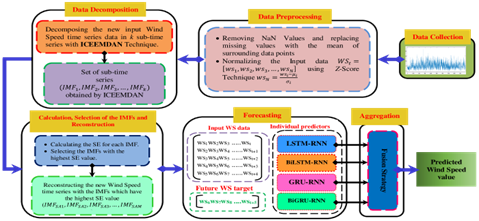
This study proposes a novel hybrid model for wind speed forecasting (WSF) based on a three-stage framework comprising decomposition, feature selection, and forecasting. The proposed approach employs Improved Complete Ensemble Empirical Mode Decomposition with Adaptive Noise (ICEEMDAN) to decompose wind speed time series into Intrinsic Mode Functions (IMFs). A distinctive contribution of this study is the use of sample entropy as a feature selection mechanism to identify the most relevant Intrinsic Mode Functions (IMFs). The selected IMFs are then integrated through a classification-based fusion technique, significantly enhancing forecasting accuracy and distinguishing this approach from conventional methods. Two distinct forecasting approaches are evaluated using multiple performance metrics, including RMSE, MAE, MAPE, and R². The first approach applies the fusion technique directly to the original wind speed time series, while the second incorporates ICEEMDAN to decompose the time series. Experimental validation using two real-world datasets from Algeria demonstrates the superiority of the proposed hybrid model over individual forecasting models, yielding significant improvements in prediction accuracy, robustness, and stability. These findings underscore the effectiveness of the three-stage framework, offering a reliable and efficient solution for short-term wind speed forecasting, with potential applications in renewable energy management and grid optimization.

Graphical Abstract

A Novel Approach for Accurate Wind Speed Time Series Forecasting Using ICEEMDAN Decomposition and Sample Entropy through Integration of Deep Learning Models
Keywords

Subjects


  1. Kaygusuz K. Renewable energy: Power for a sustainable future. Energy exploration & exploitation. 2001;19(6):603-26. https://doi.org/10.1260/0144598011492723
  2. Valdivia-Bautista SM, Domínguez-Navarro JA, Pérez-Cisneros M, Vega-Gómez CJ, Castillo-Téllez B. Artificial intelligence in wind speed forecasting: A review. Energies. 2023;16(5):2457. https://doi.org/10.3390/en16052457
  3. Chinforoush N, Latif SG. A novel method for forecasting surface wind speed using wind-direction based on hierarchical Markov model. International Journal of Engineering, Transactions B: Applications. 2021;34 (2):414-26. https://doi.org/10.5829/IJE.2021.34.02B.13
  4. Wang Y, Zou R, Liu F, Zhang L, Liu Q. A review of wind speed and wind power forecasting with deep neural networks. Applied energy. 2021;304:117766. https://doi.org/10.1016/j.apenergy.2021.117766
  5. Bosch JL, Zheng Y, Kleissl J. Deriving cloud velocity from an array of solar radiation measurements. Solar Energy. 2013;87:196-203. https://doi.org/10.1016/j.solener.2012.10.020
  6. Lydia M, Edwin Prem Kumar G, Akash R. Wind speed and wind power forecasting models. Energy & Environment. 2024:0958305X241228515. https://doi.org/10.1177/0958305X241228515
  7. Xiong Z, Yao J, Huang Y, Yu Z, Liu Y. A wind speed forecasting method based on EMD-MGM with switching QR loss function and novel subsequence superposition. Applied Energy. 2024;353:122248. https://doi.org/10.1016/j.apenergy.2023.122248
  8. Ran M, Huang J, Qian W, Zou T, Ji C. EMD-based gray combined forecasting model-Application to long-term forecasting of wind power generation. Heliyon. 2023;9(7). https://doi.org/10.1016/j.heliyon.2023.e18053
  9. Parri S, Teeparthi K, Kosana V. A hybrid methodology using VMD and disentangled features for wind speed forecasting. Energy. 2024;288:129824. https://doi.org/10.1016/j.energy.2023.129824
  10. Parri S, Teeparthi K, Kosana V. A hybrid VMD based contextual feature representation approach for wind speed forecasting. Renewable Energy. 2023;219:119391. https://doi.org/10.1016/j.renene.2023.119391
  11. Li N, Dong J, Liu L, Li H, Yan J. A novel EMD and causal convolutional network integrated with Transformer for ultra short-term wind power forecasting. International Journal of Electrical Power & Energy Systems. 2023;154:109470. https://doi.org/10.1016/j.ijepes.2023.109470
  12. Xia H, Zheng J, Chen Y, Jia H, Gao C. Short-term wind speed combined forecasting model based on multi-decomposition algorithms and frameworks. Electric Power Systems Research. 2024;227:109890. https://doi.org/10.1016/j.epsr.2023.109890
  13. Wu H, Meng K, Fan D, Zhang Z, Liu Q. Multistep short-term wind speed forecasting using transformer. Energy. 2022;261:125231. https://doi.org/10.1016/j.energy.2022.125231
  14. Fei N, Gao Y, Lu Z, Xiang T, editors. Z-score normalization, hubness, and few-shot learning. Proceedings of the IEEE/CVF International Conference on Computer Vision; 2021.
  15. Colominas MA, Schlotthauer G, Torres ME. Improved complete ensemble EMD: A suitable tool for biomedical signal processing. Biomedical Signal Processing and Control. 2014;14:19-29. https://doi.org/10.1016/j.bspc.2014.06.009
  16. Ghimire S, Deo RC, Casillas-Perez D, Salcedo-Sanz S. Improved complete ensemble empirical mode decomposition with adaptive noise deep residual model for short-term multi-step solar radiation prediction. Renewable Energy. 2022;190:408-24. https://doi.org/10.1016/j.renene.2022.03.120
  17. Xia X, Wang X. A Novel Hybrid Model for Short‐Term Wind Speed Forecasting Based on Twice Decomposition, PSR, and IMVO‐ELM. Complexity. 2022;2022(1):4014048. https://doi.org/10.1155/2022/4014048
  18. Richman JS, Moorman JR. Physiological time-series analysis using approximate entropy and sample entropy. American journal of physiology-heart and circulatory physiology. 2000;278(6):H2039-H49.
  19. Yao P, Xue J, Zhou K, Wang X. Sample Entropy‐Based Approach to Evaluate the Stability of Double‐Wire Pulsed MIG Welding. Mathematical Problems in Engineering. 2014;2014(1):869631. https://doi.org/10.1155/2014/869631
  20. Che J, Ye Y, Wang H, Huang W. A Sample Entropy Parsimonious Model Using Decomposition-ensemble with SSA and CEEMDAN for Short-term Wind Speed Prediction. Engineering Letters. 2023;31(1).
  21. Hochreiter S, Schmidhuber J. Long short-term memory. Neural computation. 1997;9(8):1735-80. https://doi.org/10.1162/neco.1997.9.8.1735
  22. Gers FA, Schmidhuber J, Cummins F. Learning to forget: Continual prediction with LSTM. Neural computation. 2000;12(10):2451-71. https://doi.org/10.1162/089976600300015015
  23. Qadeer K, Rehman WU, Sheri AM, Park I, Kim HK, Jeon M. A long short-term memory (LSTM) network for hourly estimation of PM2. 5 concentration in two cities of South Korea. Applied Sciences. 2020;10(11):3984. https://doi.org/10.3390/app10113984
  24. Wang K, Qi X, Liu H. Photovoltaic power forecasting based LSTM-Convolutional Network. Energy. 2019;189:116225. https://doi.org/10.1016/j.energy.2019.116225
  25. Ai X, Li S, Xu H. Short-term wind speed forecasting based on two-stage preprocessing method, sparrow search algorithm and long short-term memory neural network. Energy Reports. 2022;8:14997-5010. https://doi.org/10.1016/j.egyr.2022.11.051
  26. Sedai A, Dhakal R, Gautam S, Dhamala A, Bilbao A, Wang Q, et al. Performance analysis of statistical, machine learning and deep learning models in long-term forecasting of solar power production. forecasting. 2023;5(1):256-84. https://doi.org/10.3390/forecast5010014
  27. Schuster M, Paliwal KK. Bidirectional recurrent neural networks. IEEE transactions on Signal Processing. 1997;45(11):2673-81. https://doi.org/10.1109/78.650093
  28. Li J, Song Z, Wang X, Wang Y, Jia Y. A novel offshore wind farm typhoon wind speed prediction model based on PSO–Bi-LSTM improved by VMD. Energy. 2022;251:123848. https://doi.org/10.1016/j.energy.2022.123848
  29. Liu X, Lin Z, Feng Z. Short-term offshore wind speed forecast by seasonal ARIMA-A comparison against GRU and LSTM. Energy. 2021;227:120492. https://doi.org/10.1016/j.energy.2021.120492
  30. Zhang G, Liu D. Causal convolutional gated recurrent unit network with multiple decomposition methods for short-term wind speed forecasting. Energy Conversion and Management. 2020;226:113500. https://doi.org/10.1016/j.enconman.2020.113500
  31. Haque E, Tabassum S, Hossain E. A comparative analysis of deep neural networks for hourly temperature forecasting. IEEE Access. 2021;9:160646-60. https://doi.org/10.1109/ACCESS.2021.3131533
  32. Bibi I, Akhunzada A, Malik J, Iqbal J, Musaddiq A, Kim S. A dynamic DL-driven architecture to combat sophisticated Android malware. IEEE Access. 2020;8:129600-12. https://doi.org/10.1109/ACCESS.2020.3009819
  33. Zhang Y, Zhang L, Sun D, Jin K, Gu Y. Short-term wind power forecasting based on VMD and a hybrid SSA-TCN-BiGRU network. Applied Sciences. 2023;13(17):9888. https://doi.org/10.3390/app13179888
  34. Tao C, Tao T, He S, Bai X, Liu Y. Wind turbine blade icing diagnosis using B-SMOTE-Bi-GRU and RFE combined with icing mechanism. Renewable Energy. 2024;221:119741. https://doi.org/10.1016/j.renene.2023.119741
  35. Zemouri N, Bouzgou H, Gueymard CA. Multimodel ensemble approach for hourly global solar irradiation forecasting. The European Physical Journal Plus. 2019;134(12):594. https://doi.org/10.1140/epjp/i2019-12966-5
  36. Bouzgou H, Benoudjit N. Multiple architecture system for wind speed prediction. Applied Energy. 2011;88(7):2463-71. https://doi.org/10.1016/j.apenergy.2011.01.037
  37. Bruzzone L, Melgani F. Robust multiple estimator systems for the analysis of biophysical parameters from remotely sensed data. IEEE Transactions on Geoscience and Remote Sensing. 2005;43(1):159-74. https://doi.org/10.1109/TGRS.2004.839818
  38. Liu H, Mi X, Li Y, Duan Z, Xu Y. Smart wind speed deep learning based multi-step forecasting model using singular spectrum analysis, convolutional Gated Recurrent Unit network and Support Vector Regression. Renewable energy. 2019;143:842-54. https://doi.org/10.1016/j.renene.2019.05.039
  39. Xiang L, Li J, Hu A, Zhang Y. Deterministic and probabilistic multi-step forecasting for short-term wind speed based on secondary decomposition and a deep learning method. Energy Conversion and Management. 2020;220:113098. https://doi.org/10.1016/j.enconman.2020.113098
  40. Chitsazan MA, Fadali MS, Trzynadlowski AM. Wind speed and wind direction forecasting using echo state network with nonlinear functions. Renewable energy. 2019;131:879-89. https://doi.org/10.1016/j.renene.2018.07.060
  41. Chen L, Li Z, Zhang Y. Multiperiod‐ahead wind speed forecasting using deep neural architecture and ensemble learning. Mathematical Problems in Engineering. 2019;2019(1):9240317. https://doi.org/10.1155/2019/9240317
  42. Peng Z, Peng S, Fu L, Lu B, Tang J, Wang K, et al. A novel deep learning ensemble model with data denoising for short-term wind speed forecasting. Energy Conversion and Management. 2020;207:112524. https://doi.org/10.1016/j.enconman.2020.112524