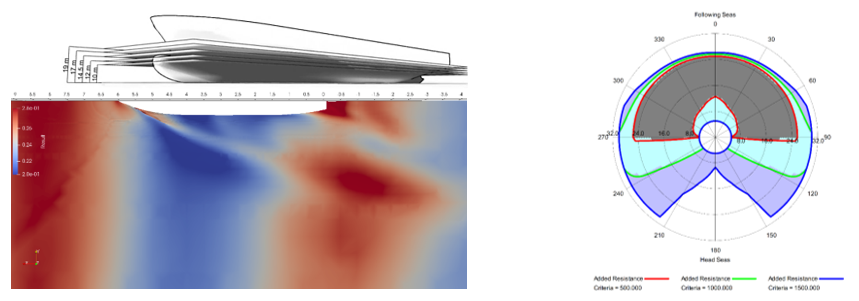
To predict the ship's behavior in the real sea state, it is important to know its dynamic responses and added resistance in different physical and environmental conditions. Therefore, the current study employs the hybrid CFD-strip theory method to study the added resistance and dynamic responses (i.e., heave and pitch RAOs) of the DTC hull. For this purpose, different wavelengths and directions and various ship drafts and trims were considered as defined physical and environmental parameters. In addition, for the CFD approach, the finite volume method (FVM) using open source software of OpenFOAM was used, while the strip theory method was applied using Tribon. The results of the CFD and strip theory have been validated against the published experimental and numerical data, and an acceptable accordance was achieved. The obtained results indicate that an enhancement in incident wave angles increases heave and pitch RAOs. Moreover, draft change has a non-uniform effect on heave RAO, while draft reduction causes higher pitch RAO. An increase in trim by aft results in higher heave RAO. Moreover, an enhancement in trim by the bow increases the pitch RAO. Finally, the highest added resistance is achieved at the head sea for the small draft of T= 12 m and trim by bow 0.6 ° in case of wavelength equal to ship length.
Park D-M, Kim Y, Seo M-G, Lee J. Study on added resistance of a tanker in head waves at different drafts. Ocean Engineering. 2016;111:569-81. https://doi.org/10.1016/j.oceaneng.2015.11.026
Sprenger F, Hassani V, Maron A, Delefortrie G, Van Zwijnsvoorde T, Cura-Hochbaum A, et al., editors. Establishment of a validation and benchmark database for the assessment of ship operation in adverse conditions. International Conference on Offshore Mechanics and Arctic Engineering; 2016: American Society of Mechanical Engineers.
Park D-M, Lee J-H, Jung Y-W, Lee J, Kim Y, Gerhardt F. Experimental and numerical studies on added resistance of ship in oblique sea conditions. Ocean Engineering. 2019;186:106070. https://doi.org/10.1016/j.oceaneng.2019.05.052
Liu S, Sprenger F, Papanikolaou A, Dafermos G, Zaraphonitis G. Experimental and numerical studies on linear and nonlinear seakeeping phenomena of the DTC ship in regular waves. Ship Technology Research. 2021;68(1):41-61. https://doi.org/10.1080/09377255.2020.1857007
Kinaci OK, Gokce MK, Delen C. Resistance experiments and self-propulsion estimations of Duisburg Test Case at 1/100 scale. Ship Technology Research. 2020;67(2):109-20. https://doi.org/10.1080/09377255.2020.1729454
Lee J-H, Kim Y, Kim B-S, Gerhardt F. Comparative study on analysis methods for added resistance of four ships in head and oblique waves. Ocean Engineering. 2021;236:109552. https://doi.org/10.1016/j.oceaneng.2021.109552
Chirosca A-M, Medina A, Pacuraru F, Saettone S, Rusu L, Pacuraru S. Experimental and numerical investigation of the added resistance in regular head waves for the DTC hull. Journal of Marine Science and Engineering. 2023;11(4):852. https://doi.org/10.3390/jmse11040852
Sadat-Hosseini H, Wu P-C, Carrica PM, Kim H, Toda Y, Stern F. CFD verification and validation of added resistance and motions of KVLCC2 with fixed and free surge in short and long head waves. Ocean Engineering. 2013;59:240-73. https://doi.org/10.1016/j.oceaneng.2012.12.016
Gasparotti C, Rusu L. Seakeeping performance assessment for a containership in a specific sea area. Mechanical Testing and Diagnosis. 2013;3(1):38-48.
Liu S, Papanikolaou A, editors. Prediction of the added resistance of ships in oblique seas. ISOPE International Ocean and Polar Engineering Conference; 2016: ISOPE.
Islam H, Akimoto H, editors. Prediction of ship resistance in Head Waves Using RaNS based solver. AIP Conference Proceedings; 2016: AIP Publishing.
Moctar Oe, Sigmund S, Ley J, Schellin TE. Numerical and experimental analysis of added resistance of ships in waves. Journal of Offshore Mechanics and Arctic Engineering. 2017;139(1):011301. https://doi.org/10.1115/1.4034205
Papanikolaou A, Fournarakis N, Chroni D, Liu S, Plessas T, Sprenger F, editors. Simulation of the maneuvering behavior of ships in adverse weather conditions. Proceedings; 2016.
He R, Zhang Z, Wang X, Feng D, editors. Numerical simulation of the ship bottom interaction of DTC container carrier for different keel clearance in pure sway motion. Proceedings of the 4th International Conference on Ship Manoeuvering in Shallow and Confined Water (MASHCON): Ship-Bottom interaction, Hamburg, Germany; 2016.
Liu C, Wang J, Wan D, Yu X, editors. Computation of Wave Drift Forces and Motions of DTC Ship in Oblique Waves. ISOPE International Ocean and Polar Engineering Conference; 2017: ISOPE.
Liu C, Wang J, Wan D. CFD computation of wave forces and motions of DTC ship in oblique waves. International journal of offshore and polar engineering. 2018;28(02):154-63. https://doi.org/10.17736/ijope.2018.sh21
Liu C, Chen G, Wan D, editors. CFD Study of Added Resistance and Motion of DTC in Short and Long Waves. International Conference on Offshore Mechanics and Arctic Engineering; 2018: American Society of Mechanical Engineers.
Srivastava A, Akhtar H, Gupta A, Kumar R. Hydrodynamic Analysis of the Ship Hull. Int J Emerg Technol Eng Res. 2019;4:25-8.
Martic I, Chillcce G, Tello Ruiz M, Ramirez J, Degiuli N, Ould el Moctar B, editors. Numerical assessment of added resistance in waves of the DTC container ship in finite water depths. 5th Mashcon; 2019: Knowledge centre for manoeuvring in shallow and confined water.
Deng G, Guilmineau E, Leroyer A, Queutey P, Visonneau M, Wackers J, editors. Simulation of container ship in shallow water at model scale and full scale. Third Chinese National CFD Symposium on Ship and Offshore Engineering; 2014.
Chirosca A, Gasparotti C. Comparison between model test and numerical simulations for a container ship. Maritime Technology and Engineering 5 Volume 2: CRC Press; 2021. p. 75-80.
Amini-Afshar M. Salvesen’s method for added resistance revisited. Journal of Offshore Mechanics and Arctic Engineering. 2021;143(5):051902. https://doi.org/10.1115/1.4050213
Kobayashi H, Kume K, Orihara H, Ikebuchi T, Aoki I, Yoshida R, et al. Parametric study of added resistance and ship motion in head waves through RANS: Calculation guideline. Applied Ocean Research. 2021;110:102573. https://doi.org/10.1016/j.apor.2021.102573
Mikkelsen H, Shao Y, Walther JHH, editors. CFD verification and validation of added resistance and seakeeping response in regular oblique waves with varying wave length: Paper 176. The 9th Conference on Computational Methods in Marine Engineering (Marine 2021); 2022.
Kinaci OK, Ozturk D. Straight-ahead self-propulsion and turning maneuvers of DTC container ship with direct CFD simulations. Ocean Engineering. 2022;244:110381. https://doi.org/10.1016/j.oceaneng.2021.110381
Fang X, Yu J, Yao C, Zhang Z, Wang X, editors. Numerical study on wave-induced drift forces and motions of a DTC ship in head and oblique waves using functional decomposition model. IOP Conference Series: Materials Science and Engineering; 2023: IOP Publishing.
Chowdhury JI, Faieq A, Amin OM. Seakeeping analysis of a tanker with hard sail-based wind propulsion system in various seaways. Ocean Engineering. 2023;278:114481. https://doi.org/10.1016/j.oceaneng.2023.114481
Liu S, Shang B, Papanikolaou A, Bolbot V. Improved formula for estimating added resistance of ships in engineering applications. Journal of Marine Science and Application. 2016;15:442-51. https://doi.org/10.1007/s11804-016-1377-3
Liu S, Papanikolaou A. On the prediction of the added resistance of large ships in representative seaways. Ships and Offshore Structures. 2017;12(5):690-6. https://doi.org/10.1080/17445302.2016.1200452
Islam H, Ventura M, Soares CG, Tadros M, Abdelwahab H. Comparison between empirical and CFD based methods for ship resistance and power prediction. Trends in maritime technology and engineering. 2022:347-57.
Lee J-H, Kim B-S, Kim Y. Study on steady flow effects in numerical computation of added resistance of ship in waves. Journal of Advanced Research in Ocean Engineering. 2017;3(4):193-203. https://doi.org/10.5574/JAROE.2017.3.4.193
Amini-Afshar M, Bingham HB. Added resistance using Salvesen–Tuck–Faltinsen strip theory and the Kochin function. Applied Ocean Research. 2021;106:102481. https://doi.org/10.1016/j.apor.2020.102481
Song X, Zhang X, Beck RF. Numerical study on added resistance of ships based on time-domain desingularized-Rankine panel method. Ocean Engineering. 2022;248:110713. https://doi.org/10.1016/j.oceaneng.2022.110713
Kashiwagi M. Numerical seakeeping calculations based on slender ship theory. Schiffstechnik. 1997;44(4):167-92.
Larsson L, Stern F, Visonneau M, editors. Numerical ship hydrodynamics. An assessment of the Gothenburg 2010 Workshop; 2014: Springer.
ITTC R. procedures and guidelines: practical guidelines for ship CFD applications, 7.5. ITTC: Boulder, CO, USA. 2011.
Stern F, Guilmineau E, Visonneau M, Toxopeus S, Simonsen C, Aram S, et al. CFD Validation for Surface Combatant 5415 at Straight-Ahead and 20 Degree Static Drift Conditions: NATO RTO/AVT-183, Technical Report; 2015.
Mousaviraad SM, He W, Diez M, Stern F. Framework for convergence and validation of stochastic uncertainty quantification and relationship to deterministic verification and validation. International Journal for Uncertainty Quantification. 2013;3(5). 10.1615/Int.J.UncertaintyQuantification.2012003594
Diez M, He W, Campana EF, Stern F. Uncertainty quantification of Delft catamaran resistance, sinkage and trim for variable Froude number and geometry using metamodels, quadrature and Karhunen–Loève expansion. Journal of Marine Science and Technology. 2014;19:143-69. https://doi.org/10.1007/s00773-013-0235-0
Lang X, Mao W. A semi-empirical model for ship speed loss prediction at head sea and its validation by full-scale measurements. Ocean Engineering. 2020;209:107494. https://doi.org/10.1016/j.oceaneng.2020.107494
TIN YADANAR T. Ship Hull Optimization in Calm Water and Moderate Sea States. 2016.
Taghva HR, Ghassemi H, Nowruzi H. Seakeeping performance estimation of the container ship under irregular wave condition using artificial neural network. Am J Civil Eng Archit. 2018;6(4):147-53. https://doi.org/10.12691/ajcea-6-4-3
Najafi A, Nowruzi H, Ghassemi H. Performance prediction of hydrofoil-supported catamarans using experiment and ANNs. Applied Ocean Research. 2018;75:66-84. https://doi.org/10.1016/j.apor.2018.02.017
Kazemi H, Doustdar MM, Najafi A, Nowruzi H, Ameri MJ. Hydrodynamic performance prediction of stepped planing craft using CFD and ANNs. Journal of Marine Science and Application. 2021;20:67-84. https://doi.org/10.1007/s11804-020-00182-y
Yousefifard M, Nowruzi H. Hydrodynamic performance of sandglass-type floating body with damping appendages. Ocean Engineering. 2024;309:118579. https://doi.org/10.1016/j.oceaneng.2024.118579
Yousefifard M, Maboodi A. Numerical and experimental study of the stern wedge effects on the hydrodynamics performance of a semi-displacement catamaran in calm water. Journal of Applied Fluid Mechanics. 2020;14(2):401-15. https://doi.org/10.47176/jafm.14.02.31361
Elsherbiny K. Experimental and numerical analysis of the squat and resistance of ships advancing through the new Suez Canal. 2020.
Nazemian A, Ghadimi P. Global optimization of trimaran hull form to get minimum resistance by slender body method. Journal of the Brazilian Society of Mechanical Sciences and Engineering. 2021;43(2):67. https://doi.org/10.1007/s40430-020-02791-8
Ahmadi,M. , Yousefifard,M. and Nowruzi,H. (2026). Dynamic Performance and Added Resistance of Duisburg Test Case Ship Using Hybrid CFD- Strip Theory Method. International Journal of Engineering, 39(2), 321-340. doi: 10.5829/ije.2026.39.02b.04
MLA
Ahmadi,M. , , Yousefifard,M. , and Nowruzi,H. . "Dynamic Performance and Added Resistance of Duisburg Test Case Ship Using Hybrid CFD- Strip Theory Method", International Journal of Engineering, 39, 2, 2026, 321-340. doi: 10.5829/ije.2026.39.02b.04
HARVARD
Ahmadi M., Yousefifard M., Nowruzi H. (2026). 'Dynamic Performance and Added Resistance of Duisburg Test Case Ship Using Hybrid CFD- Strip Theory Method', International Journal of Engineering, 39(2), pp. 321-340. doi: 10.5829/ije.2026.39.02b.04
CHICAGO
M. Ahmadi, M. Yousefifard and H. Nowruzi, "Dynamic Performance and Added Resistance of Duisburg Test Case Ship Using Hybrid CFD- Strip Theory Method," International Journal of Engineering, 39 2 (2026): 321-340, doi: 10.5829/ije.2026.39.02b.04
VANCOUVER
Ahmadi M., Yousefifard M., Nowruzi H. Dynamic Performance and Added Resistance of Duisburg Test Case Ship Using Hybrid CFD- Strip Theory Method. IJE, 2026; 39(2): 321-340. doi: 10.5829/ije.2026.39.02b.04