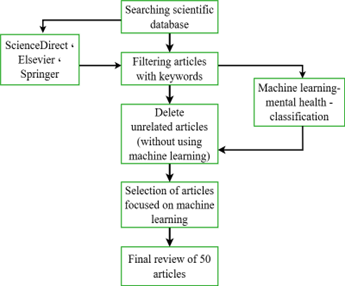
Mental health conditions, including anxiety, represent major challenges on a global scale. These illnesses encompass a range of conditions that disrupt thought patterns and behavior, often leading to significant discomfort or disability for those affected. the field of data mining has gained prominence in medicine, offering innovative tools to uncover hidden insights and enhance disease classification, particularly in mental health. This analytical method is essential for uncovering valuable patterns in large datasets, enabling better understanding and diagnosis of complex disorders. The purpose of this article is to investigate neurological and mental diseases using machine learning algorithms and to identify the most used algorithm in each disease. The method used in this article is machine learning algorithms and it is the most widely used and most important algorithm in each of the neurological and mental diseases. The results show that the SVM algorithm emerged as the most frequently employed method, followed closely by random forest and decision tree algorithms. These techniques demonstrate the growing importance of machine learning in enhancing diagnostic capabilities and deepening our understanding of mental health disorders. This research focuses on utilizing machine learning techniques to assist in diagnosing neurological and mental health conditions. By analyzing studies conducted between 2005 and 2024, the review evaluates conditions such as schizophrenia, depression, bipolar disorder and Alzheimer. A total of 50 studies were selected based on their relevance to machine learning applications in this domain.
Dooshima MP, Chidozie EN, Ademola BJ, Sekoni OO, Adebayo IP. A predictive model for the risk of mental illness in Nigeria using data mining. International Journal of Immunology. 2018;6(1):5-16. https://doi.org/10.11648/j.iji.20180601.12
Dhaka P, Johari R, editors. Big data application: Study and archival of mental health data, using MongoDB. 2016 International Conference on Electrical, Electronics, and Optimization Techniques (ICEEOT); 2016: IEEE.
Alonso SG, de La Torre-Díez I, Hamrioui S, López-Coronado M, Barreno DC, Nozaleda LM, et al. Data mining algorithms and techniques in mental health: a systematic review. Journal of medical systems. 2018;42:1-15. https://doi.org/10.1007/s10916-018-1018-2
Ghorbani R, Ghousi R. Predictive data mining approaches in medical diagnosis: A review of some diseases prediction. International Journal of Data and Network Science. 2019;3(2):47-70. https://doi.org/10.5267/j.ijdns.2019.1.003
Vaishnavi K, Kamath UN, Rao BA, Reddy NS, editors. Predicting mental health illness using machine learning algorithms. Journal of Physics: Conference Series; 2022: IOP Publishing.
Sarno R, Ghozali I. Multi-class multi-level classification of mental health disorders based on textual data from social media. Journal of Information and Communication Technology. 2024;23(1):77-104. https://doi.org/10.32890/jict2024.23.1.4
Laijawala V, Aachaliya A, Jatta H, Pinjarkar V, editors. Mental health prediction using data mining: a systematic review. Proceedings of the 3rd international conference on advances in science & technology (ICAST); 2020.
Iyortsuun NK, Kim S-H, Jhon M, Yang H-J, Pant S, editors. A review of machine learning and deep learning approaches on mental health diagnosis. Healthcare; 2023: MDPI.
Jiang F, Jiang Y, Zhi H, Dong Y, Li H, Ma S, et al. Artificial intelligence in healthcare: past, present and future. Stroke and vascular neurology. 2017;2(4). https://doi.org/10.1136/svn-2017-000101
Lai JW, Ang CKE, Acharya UR, Cheong KH. Schizophrenia: a survey of artificial intelligence techniques applied to detection and classification. International journal of environmental research and public health. 2021;18(11):6099. https://doi.org/10.3390/ijerph18116099
Organization WH. WHO guidelines on mental health at work: World Health Organization; 2022.
Pirooznia M, Seifuddin F, Judy J, Mahon PB, Potash JB, Zandi PP, et al. Data mining approaches for genome-wide association of mood disorders. Psychiatric genetics. 2012;22(2):55-61. https://doi.org/10.1097/YPG.0b013e32834dc40d
Abd Rahman R, Omar K, Noah SAM, Danuri MSNM, Al-Garadi MA. Application of machine learning methods in mental health detection: a systematic review. Ieee Access. 2020;8:183952-64. https://doi.org/10.1109/ACCESS.2020.3029154
Zhang T, Schoene AM, Ji S, Ananiadou S. Natural language processing applied to mental illness detection: a narrative review. NPJ digital medicine. 2022;5(1):46. https://doi.org/10.1038/s41746-022-00589-7
Lin H, Jia J, Qiu J, Zhang Y, Shen G, Xie L, et al. Detecting stress based on social interactions in social networks. IEEE Transactions on Knowledge and Data Engineering. 2017;29(9):1820-33. https://doi.org/10.1109/TKDE.2017.2686382
Bali RK. Clinical knowledge management: opportunities and challenges. 2005.
Tomar D, Agarwal S. A survey on Data Mining approaches for Healthcare. International Journal of Bio-Science and Bio-Technology. 2013;5(5):241-66. https://doi.org/10.14257/ijbsbt.2013.5.5.25
Samms KO. Data Mining and Analysis. 2015.
Hamedani P, Sadr S, Shoulaei A. Independent fuzzy logic control of two five-phase linear induction motors supplied from a single voltage source inverter. Journal of Electrical and Computer Engineering Innovations (JECEI). 2022;10(1):195-208. https://doi.org/10.22061/jecei.2021.8091.479
Vanaja S, Rameshkumar K. Performance analysis of classification algorithms on medical diagnoses-a survey. Journal of Computer Science. 2015;11(1):31. https://doi.org/10.3844/jcssp.2015.30.52
Gundecha P, Liu H. Mining social media: a brief introduction. New directions in informatics, optimization, logistics, and production. 2012:1-17. https://doi.org/10.1287/educ.1120.0105
Zafarani R, Abbasi MA, Liu H. Social media mining: an introduction: Cambridge University Press; 2014.
Srinivasan SM, Martin M, Tripathi A. ANN based data mining analysis of the Parkinson’s disease. International Journal of Computer Applications. 2017;168(1):56-60. https://doi.org/10.5120/ijca2017914254
Khan SI, Islam A, Hossen A, Zahangir TI, Hoque ASML, editors. Supporting the treatment of mental diseases using data mining. 2018 International Conference on Innovations in Science, Engineering and Technology (ICISET); 2018: IEEE.
Deziel M, Olawo D, Truchon L, Golab L, editors. Analyzing the mental health of engineering students using classification and regression. Educational data mining 2013; 2013.
Parsapour F, Peymani J. Using data mining techniques for intelligent diagnosis of severity of depressive disorder. Journal of Health and Biomedical Informatics. 2020;7(3):252-62.
Prakash V, Kumar D. A modified gated recurrent unit approach for epileptic electroencephalography classification. Journal of Information and Communication Technology. 2023;22(4):587-617. https://doi.org/10.32890/jict2023.22.4.3
Walker AE, Spring JD, Travis MJ. Addressing cognitive deficits in schizophrenia: toward a neurobiologically informed approach. Biological psychiatry. 2017;81(1):e1-e3. https://doi.org/10.1016/j.biopsych.2016.10.023
Allende-Cid H, Zamora J, Alfaro-Faccio P, Alonso-Sánchez MF. A machine learning approach for the automatic classification of schizophrenic discourse. IEEE Access. 2019;7:45544-53. https://doi.org/10.1109/ACCESS.2019.2908620
Almutairi MM, Alhamad N, Alyami A, Alshobbar Z, Alfayez H, Al-Akkas N, et al., editors. Preemptive diagnosis of schizophrenia disease using computational intelligence techniques. 2019 2nd International Conference on Computer Applications & Information Security (ICCAIS); 2019: IEEE.
Góngora Alonso S, Marques G, Agarwal D, De la Torre Díez I, Franco-Martín M. Comparison of machine learning algorithms in the prediction of hospitalized patients with schizophrenia. Sensors. 2022;22(7):2517. https://doi.org/10.3390/s22072517
Montazeri M, Montazeri M, Bahaadinbeigy K, Montazeri M, Afraz A. Application of machine learning methods in predicting schizophrenia and bipolar disorders: A systematic review. Health science reports. 2023;6(1):e962. https://doi.org/10.1002/hsr2.962
Hettige NC, Nguyen TB, Yuan C, Rajakulendran T, Baddour J, Bhagwat N, et al. Classification of suicide attempters in schizophrenia using sociocultural and clinical features: A machine learning approach. General hospital psychiatry. 2017;47:20-8. https://doi.org/10.1016/j.genhosppsych.2017.03.001
Yang H, He L, Li W, Zheng Q, Li Y, Zheng X, et al. An automatic detection method for schizophrenia based on abnormal eye movements in reading tasks. Expert Systems with Applications. 2024;238:121850. https://doi.org/10.1016/j.eswa.2023.121850
LP Costantini C, Odone A, Colucci M, Costanza A, Serafini G, Aguglia A, et al. depression, screening, primary care, Patient Health Questionnaire 9, PHQ-9. 2021. https://doi.org/10.1016/j.jad.2020.09.131
Shorey S, Ng ED, Wong CH. Global prevalence of depression and elevated depressive symptoms among adolescents: A systematic review and meta‐analysis. British Journal of Clinical Psychology. 2022;61(2):287-305. https://doi.org/10.1111/bjc.12333
Aleem S, Huda Nu, Amin R, Khalid S, Alshamrani SS, Alshehri A. Machine learning algorithms for depression: diagnosis, insights, and research directions. Electronics. 2022;11(7):1111. https://doi.org/10.3390/electronics11071111
Sau A, Bhakta I. Predicting anxiety and depression in elderly patients using machine learning technology. Healthcare Technology Letters. 2017;4(6):238-43. https://doi.org/10.1049/htl.2016.0096
Radwan A, Amarneh M, Alawneh H, Ashqar HI, AlSobeh A, Magableh AAAR. Predictive analytics in mental health leveraging LLM embeddings and machine learning models for social media analysis. International Journal of Web Services Research (IJWSR). 2024;21(1):1-22. https://doi.org/10.4018/IJWSR.338222
Sau A, Bhakta I. Screening of anxiety and depression among seafarers using machine learning technology. Informatics in Medicine Unlocked. 2019;16:100228. https://doi.org/10.1016/j.imu.2019.100228
Mukherjee S, Ashish K, Hui NB, Chattopadhyay S. Modeling depression data: feed forward neural network vs. radial basis function neural network. Am J Biomed Sci. 2014;6(3):166-74. https://doi.org/10.5099/aj140300166
Rehmani F, Shaheen Q, Anwar M, Faheem M, Bhatti SS. Depression detection with machine learning of structural and non‐structural dual languages. Healthcare Technology Letters. 2024;11(4):218-26. https://doi.org/10.1049/htl2.12088
Gadzama WA, Gabi D, Argungu MS, Suru HU. The use of machine learning and deep learning models in detecting depression on social media: A systematic literature review. Personalized Medicine in Psychiatry. 2024;45:100125. https://doi.org/10.1016/j.pmip.2024.100125
Payandeh S, editor Recursive Bayesian tracking for smart elderly living. 2016 IEEE 7th Annual Information Technology, Electronics and Mobile Communication Conference (IEMCON); 2016: IEEE.
Segovia F, Górriz J, Ramírez J, Salas-Gonzalez D, Álvarez I. Early diagnosis of Alzheimer’s disease based on partial least squares and support vector machine. Expert Systems with Applications. 2013;40(2):677-83. https://doi.org/10.1016/j.eswa.2012.07.071
Kishore P, Kumari CU, Kumar M, Pavani T. Detection and analysis of Alzheimer’s disease using various machine learning algorithms. Materials today: proceedings. 2021;45:1502-8. https://doi.org/10.1016/j.matpr.2020.07.645
Keramati Hatkeposhti R, Yadollahzadeh-Tabari M, Golsorkhtabariamiri M. Providing an approach for early prediction of fall in human activities based on wearable sensor data and the use of deep learning algorithms. The Computer Journal. 2024;67(2):658-73. https://doi.org/10.1093/comjnl/bxad008
Hatkeposhti RK, Tabari MY, GolsorkhtabariAmiri M. Fall detection using deep learning algorithms and analysis of wearable sensor data by presenting a new sampling method. International Journal of Engineering Transactions A: Basics. 2022;35(10):1941-58. https://doi.org/10.5829/ije.2022.35.10A.13
Bari Antor M, Jamil AS, Mamtaz M, Monirujjaman Khan M, Aljahdali S, Kaur M, et al. A comparative analysis of machine learning algorithms to predict Alzheimer’s disease. Journal of Healthcare Engineering. 2021;2021(1):9917919. https://doi.org/10.1155/2021/9917919
Al-Hagery MA, Al-Fairouz EI, Al-Humaidan NA. Improvement of Alzheimer disease diagnosis accuracy using ensemble methods. Indonesian Journal of Electrical Engineering and Informatics (IJEEI). 2020;8(1):132-9. https://doi.org/10.52549/ijeei.v8i1.1321
Alatrany AS, Khan W, Hussain A, Kolivand H, Al-Jumeily D. An explainable machine learning approach for Alzheimer’s disease classification. Scientific reports. 2024;14(1):2637. https://doi.org/10.1038/s41598-024-51985-w
Ahamed IU, Hossain A-A, Imam T, Islam J, editors. A Multimodal Analytical Approach to Alzheimer's Disease Diagnosis Using Machine Learning and Convolutional Neural Networks on MRI Datasets. 2024 IEEE Asia Pacific Conference on Wireless and Mobile (APWiMob); 2024: IEEE.
Tripathi T, Kumar R. Speech-based detection of multi-class Alzheimer’s disease classification using machine learning. International Journal of Data Science and Analytics. 2024;18(1):83-96. https://doi.org/10.21203/rs.3.rs-2825728/v1
Mikolas P, Marxen M, Riedel P, Bröckel K, Martini J, Huth F, et al. Prediction of estimated risk for bipolar disorder using machine learning and structural MRI features. Psychological Medicine. 2024;54(2):278-88. https://doi.org/10.1017/S0033291723001319
Chen M, Xia X, Kang Z, Li Z, Dai J, Wu J, et al. Distinguishing schizophrenia and bipolar disorder through a multiclass classification model based on multimodal neuroimaging data. Journal of Psychiatric Research. 2024;172:119-28. https://doi.org/10.1016/j.jpsychires.2024.02.024
Borges-Júnior R, Salvini R, Nierenberg AA, Sachs GS, Lafer B, Dias RS, editors. Forecasting depressive relapse in Bipolar Disorder from clinical data. 2018 IEEE International Conference on Bioinformatics and Biomedicine (BIBM); 2018: IEEE.
de Siqueira Rotenberg L, Borges-Junior RG, Lafer B, Salvini R, da Silva Dias R. Exploring machine learning to predict depressive relapses of bipolar disorder patients. Journal of Affective Disorders. 2021;295:681-7. https://doi.org/10.1016/j.jad.2021.08.127
Organization WH. The World Health Report 2001: Mental health: new understanding, new hope. 2001.
Wilens TE, Faraone SV, Biederman J. Attention-deficit/hyperactivity disorder in adults. Jama. 2004;292(5):619-23. 10.1001/jama.292.5.619
Ramzani E, Yadollahzadeh‐Tabari M, GolesorkhtabarAmiri M, Pouyan AA. Diagnosing of Parkinson's disease based on hand drawing analysis using Bi‐Directional LSTM equipped with fuzzy inferential soft‐max classifier. International Journal of Imaging Systems and Technology. 2024;34(1):e22948. https://doi.org/10.1002/ima.22948
Torabi A, Hamidi H, Safaie N. Effect of sensory experience on customer word-of-mouth intention, considering the roles of customer emotions, satisfaction, and loyalty. Journal of Engineering Transactions C: Aspects. 2021;34(3):682-99. https://doi.org/10.5829/ije.2021.34.03c.13
Hamidi H, Valizadeh A. Improvement of navigation accuracy using tightly coupled kalman filter. International Journal of Engineering-Transactions B: Applications. 2017;30(2):215-23. https://doi.org/10.5829/idosi.ije.2017.30.02b.08
Hamidi H, Daraei A. Analysis of pre-processing and post-processing methods and using data mining to diagnose heart diseases. International Journal of Engineering Transactions A: Basics 2016;29(7):921-30. https://doi.org/10.5829/idosi.ije.2016.29.07a.06
Hamidi H, Seyed Lotfali S. Analysis of role of cloud computing in providing internet banking services: Case study bank melli iran. International Journal of Engineering, Transactions B: Application. 2022;35(5):1082-8. https://doi.org/10.5829/ije.2022.35.05b.23
Hamidi H, Rafebakhsh M. Analyzing factors influencing mobile social media marketing acceptance among customers. International Journal of Engineering, Transactions C: Aspects. 2022;35(6):1209-16. https://doi.org/10.5829/ije.2022.35.06c.13
Shedthi B, Shetty V, Chadaga R, Bhat R, Preethi B, Kinki K. Implementation of Chatbot that Predicts an Illness Dynamically using Machine Learning Techniques. International Journal of Engineering Transactions B: Applications. 2024;37(2):312-22. https://doi.org/10.5829/ije.2024.37.02b.08
Medjdoubi A, Meddeber M, Yahyaoui K. Smart city surveillance: Edge technology face recognition robot deep learning based. International Journal of Engineering Transactions A: Basics 2024;37(3):25-36. https://doi.org/10.5829/ije.2024.37.01a.03
Gaurav K, Kumar A, Singh P, Kumari A, Kasar M, Suryawanshi T. Human Disease Prediction using Machine Learning Techniques and Real-life Parameters. International Journal of Engineering Transactions C: Aapects. 2023;36(6):1092-8. https://doi.org/10.5829/ije.2023.36.06c.07
Hamidi,H. and Pourmazar,S. A. H. (2026). Examination of Machine Learning Algorithms in Diagnosis of Neurological and Mental Diseases. International Journal of Engineering, 39(2), 465-484. doi: 10.5829/ije.2026.39.02b.14
MLA
Hamidi,H. , and Pourmazar,S. A. H. . "Examination of Machine Learning Algorithms in Diagnosis of Neurological and Mental Diseases", International Journal of Engineering, 39, 2, 2026, 465-484. doi: 10.5829/ije.2026.39.02b.14
HARVARD
Hamidi H., Pourmazar S. A. H. (2026). 'Examination of Machine Learning Algorithms in Diagnosis of Neurological and Mental Diseases', International Journal of Engineering, 39(2), pp. 465-484. doi: 10.5829/ije.2026.39.02b.14
CHICAGO
H. Hamidi and S. A. H. Pourmazar, "Examination of Machine Learning Algorithms in Diagnosis of Neurological and Mental Diseases," International Journal of Engineering, 39 2 (2026): 465-484, doi: 10.5829/ije.2026.39.02b.14
VANCOUVER
Hamidi H., Pourmazar S. A. H. Examination of Machine Learning Algorithms in Diagnosis of Neurological and Mental Diseases. IJE, 2026; 39(2): 465-484. doi: 10.5829/ije.2026.39.02b.14